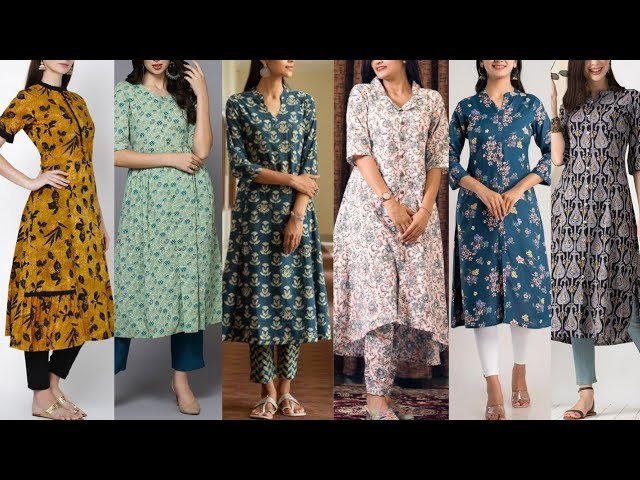
When you have a pear-shaped body — where your hips and thighs carry more volume than your shoulders and bust — finding a kurti that doesn’t just fit, but flatters, can feel like searching for harmony in a world of imbalance. You’re not looking to hide or shrink; you’re seeking resonance — a silhouette that acknowledges your curves while gently balancing your proportions, lifting your gaze, and making space for your confidence to breathe. And the A-line kurti? It’s not just a trend — it’s one of the most naturally intelligent shapes for the pear form. But not every A-line works. The magic lies in the how: where the flare begins, how wide it goes, how long it falls — all quiet metrics, invisible to the casual eye, but deeply felt on the body.
Let’s begin with the most foundational number: where the A-line starts to widen
This isn’t just about style — it’s anatomy meeting intention. For pear-shaped bodies, the ideal flare point is at or just below the natural waistline, not lower. Why? Because starting the flare too low — say, at the hip bone or mid-thigh — visually widens what’s already your fullest part, reinforcing imbalance instead of softening it. Look for Kurtis where the side seam begins its gentle outward curve no more than 1–1.5 inches below your narrowest waist point — typically right around your navel or just beneath it. You can test this mentally: if you draw an imaginary horizontal line across your true waist, the fabric should still be relatively straight up to that line — then begin its graceful, controlled widening just after. That small shift makes all the difference between “accentuating” and “aligning.”
Then comes length — not as measurement alone, but as visual rhythm
The ideal A-line kurti length for a pear shape lives in the sweet spot between the mid-hip and just above the knee — roughly 34 to 37 inches from the shoulder seam to the hem, depending on your height. Why this range? Because it ends before your widest part (the upper thigh) and after your waist — creating a clean, uninterrupted vertical line from shoulder to hem. A kurti ending at the widest part of the thigh (say, 32 inches) can unintentionally highlight volume there, while one falling below the knee (40+ inches) without structure may blur your waist-to-leg transition. The goal isn’t to cover — it’s to frame. So when you see a 35-inch kurti online, picture where that hem will land on your frame: ideally, it should sit 2–3 inches above your kneecap — elongating the leg, anchoring the eye upward, and keeping your waist the clear focal point.
Neckline depth and width are silent conductors of attention
Since the pear shape carries fullness lower down, drawing the eye upward — gently, elegantly — is key. That means necklines that open just enough to define your collarbones and shoulders, without overwhelming them. A round neckline with a 3-inch depth and a 7–8 inch width across the shoulders creates balance — wide enough to visually broaden the top third, but shallow enough to keep your neck looking long and uncluttered. A V-neck works beautifully too — if it’s modest in angle (no deeper than 4 inches from the base of the throat) and stops above the bust apex. A deep plunging V may elongate downward rather than up — so aim for a soft, inverted triangle that lifts, not dips. Boat necks? Yes — especially when they sit cleanly on the shoulder bone (not slipping down), with a gentle 1-inch drop at the sleeve head — broadening the shoulder line without adding bulk.
Sleeve shape supports, never competes
Cap sleeves — 2 to 2.5 inches deep at the shoulder drop — are quietly brilliant. They add subtle volume at the top without weighing down your frame. Three-quarter sleeves ending just below the elbow also work — their length draws the eye down the arm before it reaches the hip, creating a balanced vertical flow. Avoid puff sleeves that balloon at the shoulder or overly tight sleeves that end abruptly at the bicep — both disrupt proportion. If you love full sleeves, choose ones with a slim upper arm and gentle flare only from the elbow down — and ensure the sleeve cap is softly structured, not exaggerated.
Fabric weight and drape are your quiet allies
Light-to-medium weight fabrics — think soft cotton-viscose blends, fine rayon, or breathable chanderi — hold the A-line shape without clinging or stiffening. Heavy brocades or stiff jacquards can exaggerate hip volume by standing away from the body unnaturally. Look for fabrics with enough body to hold the A-line shape, but enough softness to drape smoothly over your curves — no pulling, no gapping, no awkward pooling at the hip. A 190–220 GSM cotton blend often hits this balance perfectly.
Embellishment placement is where design becomes dialogue
Details shouldn’t scatter — they should guide. Embroidery, mirror work, or print motifs placed along the neckline, yoke, or upper chest lift focus upward. A delicate border running vertically along the side seam — from underarm to hem — subtly elongates. But avoid large-scale prints or heavy embellishment concentrated at the hip or thigh level — that’s where the eye settles and stays, unintentionally emphasising volume. Even a simple contrast piping at the yoke or cuff adds structure at the top, helping recalibrate proportion.
Dupatta pairing — the finishing note
A matching dupatta shouldn’t compete — it should complement. Choose one in the same fabric weight and tone-on-tone shade, ideally 2.25–2.4 meters long. Drape it over one shoulder, letting the pallu fall diagonally across your torso — this creates a soft, vertical line that connects shoulder to hip, visually narrowing the lower half. Avoid overly sheer or flimsy dupattas — they flutter and distract; instead, opt for something with a gentle body that moves with you, not against you.
And finally — fit is not a number, but a feeling
Before you click “buy”, imagine slipping it on: Does the waistband sit exactly where your natural waist is — not riding down, not squeezing up? Does the flare begin there, and widen gradually, like a soft bell — not abruptly, like a funnel? When you move, does the fabric swing freely from the waist down, without catching or dragging at the hip? Does the neckline frame your face, not swallow it? These aren’t preferences — they’re physical truths written into the cut.
Because wearing an A-line kurti that truly understands your shape isn’t about illusion. It’s about integrity — of line, of proportion, of self. It’s the quiet relief of a garment that doesn’t ask you to fold yourself into it — but unfolds with you, gracefully, honestly, and wholly.
That’s not styling.
That’s symmetry — found, not forced.
How to Choose a Kurti for a Professional Look: Style, Shape & Substance
Author: Minakshi Maurya