Summer in India isn’t just heat — it’s humidity that clings, sunlight that lingers, and days where even stillness feels like effort. In that kind of weather, clothing stops being about aesthetics alone and becomes a quiet pact with comfort: Will this let me move? Will it wick? Will it stay cool by noon — not just at 9 a.m.? That’s why breathable kurtis aren’t a seasonal trend — they’re a necessity. And the good news? There’s a whole world of summer-smart kurtis—each shaped by fabric, cut, and intention—waiting to carry you through the season without sacrifice.
Let’s start with fabric—the first breath you take when you slip it on
Cotton is the obvious hero—but not all cottons are equal. Look for handloom or mulmul cotton, which is airy, gauzy, and loosely woven enough to allow airflow yet substantial enough to hold shape. Its slight irregularity isn’t a flaw—it’s proof of breathability. Then there’s linen, often misunderstood as “wrinkly and stiff”—but high-quality, pre-washed linen (especially blended with 10–20% cotton or viscose) is cool to the touch, wicks moisture brilliantly, and softens beautifully with every wash. Chanderi—especially the fine, translucent variety—shines in the summer: its silk-cotton or silk-rayon blend gives it luminosity and lightness, while the open weave lets air pass freely. And don’t overlook rayon-viscose—when responsibly made (look for OEKO-TEX certified), it mimics silk’s drape and cools like cotton, with a subtle sheen that catches the light, not the heat.
Now, cut — because fabric alone won’t save you if the shape traps air
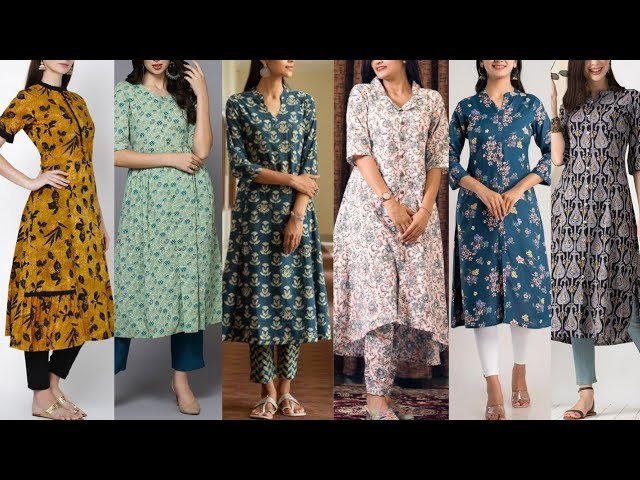
A-line kurtis remain summer staples—but only when the flare begins at the waist, not below it. Why? Because a high-flare A-line creates space around your torso and hips, letting air circulate—unlike a straight-cut kurti that may cling in humidity or a low-flare one that bunches and holds heat. Similarly, kurtis with side slits—even modest 4–6 inch openings—work like gentle vents: they release trapped warmth and allow movement without exposure. Kurtis with dolman or batwing sleeves offer volume at the shoulder, freeing up arm movement and avoiding tight underarm seams that chafe and trap sweat. And shorter lengths — think 32–35 inches — keep things light literally: less fabric = less weight, less surface area to heat up, and more leg ventilation.
Then there’s the neckline—where coolness begins
A deep V-neck or square neckline doesn’t just look elegant — it exposes collarbones and part of the upper chest, areas rich in blood vessels that help regulate body temperature. A boat neck with a soft 1-inch drop adds gentle structure without a cover. Even a classic round neck works — if it’s cut slightly wider (7–8 inches across) and deeper (3–3.5 inches) than standard, giving your neck room to breathe. Avoid high necks, turtlenecks, or tightly bound collars—they hold heat close to the skin and restrict airflow where you need it most.
Styling isn’t about layers — it’s about flow
In humid heat, your dupatta isn’t an accessory — it’s part of your thermal rhythm. Choose one in the same breathable fabric—mulmul, chiffon, or fine cotton voile—and drape it loosely over one shoulder, trailing lightly behind, or fold it into a soft scarf around your neck only when needed. Skip heavy borders or metallic thread — they add weight and reflect heat toward you. For bottoms, pair with lightweight churidars (not thick twill), slim-fit palazzos in crepe or rayon, or cotton culottes that billow just enough to catch a breeze—never cling. Footwear? Open sandals, juttis with breathable leather uppers, or even barefoot-friendly kolhapuris—anything that lets your feet breathe and stay dry.
Body shape matters — but not in the way you might think
It’s less about “hiding” and more about air management. For pear-shaped bodies, A-line kurtis starting at the waist + side slits + breathable fabric create ease.
The Real Woman’s Guide to Choosing the Right Kurti Size
Author: Minakshi Maurya